






As many as 37% of breast cancer cases may be attributable to exposure to the bovine leukemia virus.
The incidence of breast cancer continues to increase worldwide. In the United States, this amounted to a 40% increase in the incidence by the turn of the century. Presently, the main approach to preventing mortality is early detection and treatment. That’s important, but why not focus more on primary prevention—protecting people from risk factors so they don’t develop breast cancer at all?
“Overall, it is estimated that 20% of all human cancers have an infectious origin.” Viruses can trigger cancer by turning on cancer genes or turning off cancer-suppressing genes, but they can also contribute to tumor formation just by causing chronic inflammation. Currently, cancer-causing viruses are considered “the major plausible hypothesis for a direct cause of human breast cancer.” How did we get here?
It all started about 40 years ago when a professor of virology at UC Berkeley learned how the mammary tumor virus was discovered in mice. Scientists switched baby mouse pups from mothers with a high incidence of mammary cancer with the babies from mouse strains with a low incidence and found that the cancer incidence in pups matched their foster mothers’—not their biological ones’—showing it wasn’t genetic. “It occurred to me that humans are foster nursed on the cow,” the professor said.
Bovine leukemia virus (BLV) had just been identified as a cancer-causing cow virus. At the time, only about 10% of U.S. dairy cows were infected, but now it’s closer to half. Initially, 66% of herds were affected. Then, it was more like 80%, based on their milk testing positive for the virus, and 100% of the herds in the larger industrial farms. And now, more than 94% of U.S. herds are affected, continuing the historical trend of BLV persistently proliferating within U.S. dairy herds.
We’ve long known that people in countries that consume the most milk have the highest breast cancer incidence. But, as you can see below and at 2:32 in my video, Bovine Leukemia Virus as a Cause of Breast Cancerthe link between dairy consumption and breast cancer incidence isn’t only on the country level.Individual women who are lactose intolerant and consume less dairy also seem to have decreased risk of breast cancer. Milk contains many things that could be contributing to the cancer risk, such as saturated fat and the presence of cancer-promoting growth hormones like IGF-1.
Yes, we know bovine leukemia virus is present in beef and dairy products. About half of the milk and meat samples turn up positive for the virus. In fact, you can sample the virus straight out of the air on dairy farms, on surfaces, and in the milk itself. Most milk is pasteurized, but many dairy products, like raw, aged cheeses, are not. And who hasn’t eaten a pink-in-the-middle hamburger at some point in their life?
Yes, we have evidence that people are exposed to the virus. Yes, we have evidence that people are actively infected with the virus. But it wasn’t until 2015 that we learned infection rates were highest in cancerous breast tissue, as you can see below and at 3:30 in my video.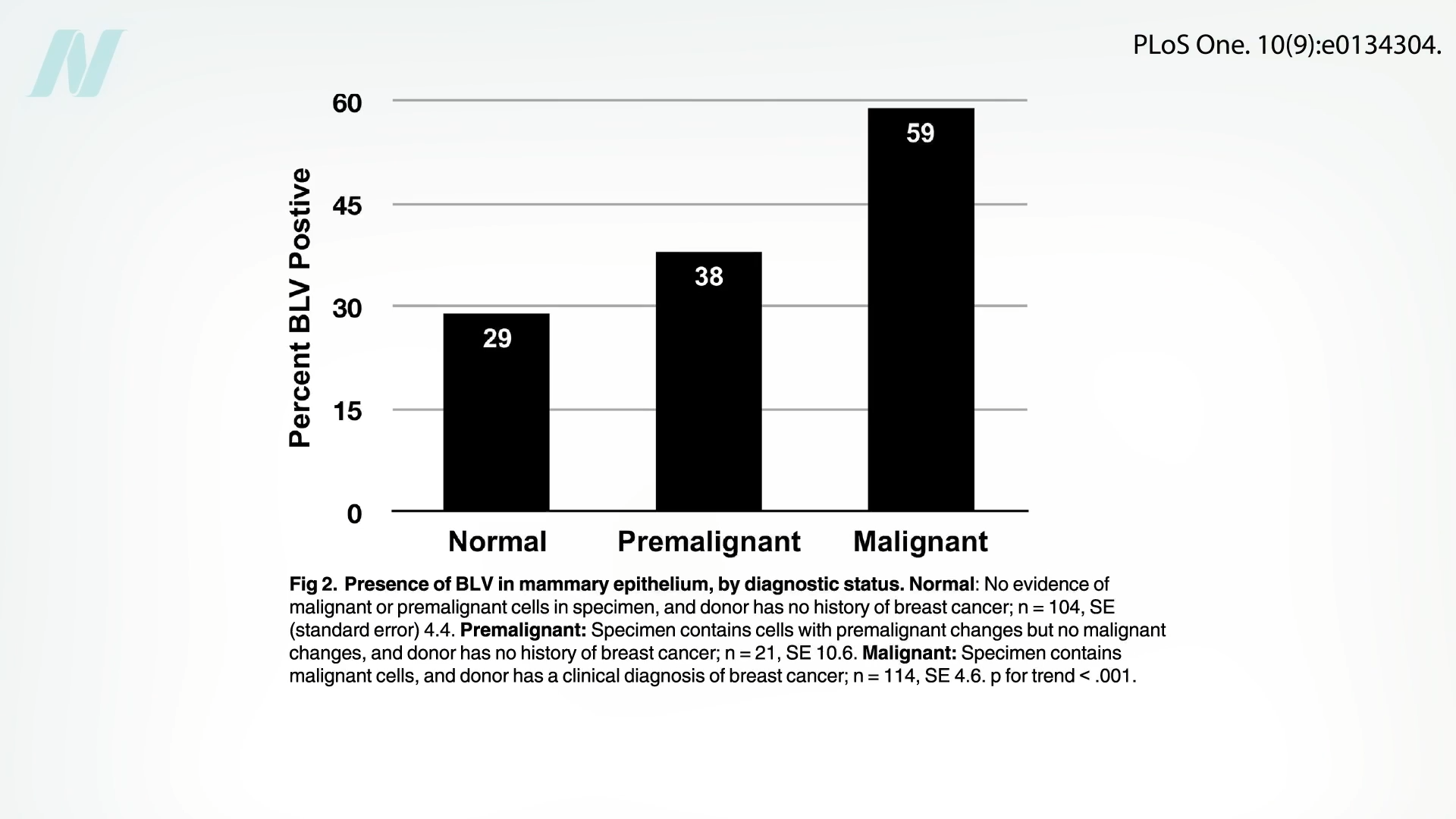

That was enough for me to make a whole series of videos on the role the virus plays in breast cancer and how the meat and dairy industries responded to the news. What’s the latest update? That’s what I’ll cover next.
Doctor’s Note
You may remember that I’ve previously discussed The Role of Bovine Leukemia in Breast Cancer and the Industry Response to Bovine Leukemia Virus in Breast Cancer.
Stay tuned for the next video: Breast Cancer and the Bovine Leukemia Virus in Meat and Dairy.


