






James Mu had braced for the call that came in late January.
A patient from his rural Northern California county had measles, a disease so rare there that many physicians have never treated a case.
While California has some of the strictest vaccine laws in the country, conservative Shasta County’s approach during the covid pandemic stood in stark contrast with the state’s guidance. Its local leaders opposed masking and vaccine mandates, and they ousted the county public health officer, who had sought to enforce those state policies and other safety measures.
A potential measles outbreak had “always been in my mind,” said Mu, an outspoken family physician who was among local doctors to sign a 2022 letter opposing covid vaccine mandates. But Mu, the county’s current public health officer, said that when his department identified the first local measles case, it acted decisively: “We forgot about fear.”
They went to work, he and his team said, to painstakingly retrace the steps of nine people sickened with measles, contacting more than 600 people who may have been exposed at Costco, a sushi restaurant, sporting events, a school, or a healthcare clinic. Just one of the nine contracted measles from one of those locations, while the others were characterized by the public health department as “close contacts.”
Two and a half months later, the Shasta County public health department had declared the measles outbreak over. Infectious disease experts say the rapid response executed in the mostly rural, vaccine-hesitant county offers a playbook for public health officers across the nation who are struggling to keep the highly contagious virus from spreading.
“To me, the story of Shasta is one of hope,” said Peter Chin-Hong, an infectious disease specialist at the University of California-San Francisco.
After more than a year of ongoing cases, measles has sickened more than 4,000 people in the U.S., according to the Centers for Disease Control and Prevention. For the first time in two decades, the U.S. is poised to lose its measles elimination status, a designation signaling that outbreaks are rare and rapidly contained.
Utah had confirmed 673 measles cases as of late May while South Carolina had seen at least 997, according to their state health departments. California had confirmed 74 cases.


Critical Rapid Response
In late January, when Shasta County identified the first case, Mu gathered with more than a dozen communicable-disease nurses, epidemiologists, and emergency and community relations staffers for an “initial threat assessment meeting.”
Measles is an airborne pathogen that can linger in a room for two hours after an infected person leaves, so on-call nurses and responders faced a daunting task figuring out exactly when the patient was infectious and where they had been.
“Everything is about speed — speed in identifying the person and finding the sites where measles were occurring,” Chin-Hong said. “If you keep it down to a few cases, it’s much easier. If you wait just a little bit longer, those people would have been in contact with a lot more people.”
Roughly 9 in 10 unvaccinated people exposed to the virus become infected. All nine of Shasta County’s confirmed cases were people who were unvaccinated or had unknown vaccination status, according to the county’s public health department. Before the department called families who may have been exposed, county nurses sometimes enlisted school principals, church staff, clinic managers, or others to make first contact, said Daniel Walker, the county’s supervising epidemiologist.
Erika Piper, the head of Redding Christian School in Palo Cedro, talked to school families wary of requests by public health officials — and government in general — to provide immunization records or other personal information. She said she also had tough but respectful conversations with families to ensure exposed, unvaccinated kids stayed home from school, so their community could abide by public health guidance calling for 21 days of isolation.
“I would say to them: ‘That’s totally fine. You have a choice. You’ve made your choice. But there are still consequences to the choices we make,’” Piper said, referring to families who had opted not to vaccinate their children. “‘And so you can either be a willing helper and a partner with me in this, and we can make it work and get through it, or you can battle me on it. But either way, you can’t be in school.’”
She allowed work to be sent home to quarantined students and personally took daily attendance at the school to help ensure health guidelines were met.
The California Department of Public Health assisted with case investigation by making calls to exposed people at the county’s request and deployed a covid-era phone system, CalCONNECT, that automates symptom monitoring for exposed contacts.
Shasta officials warned people not to be wary of calls from contract tracers using a 279 area code, worrying they would dismiss them as scams.
Delicate Conversations
In Shasta County, the measles vaccination rate is just below the 95% threshold for community-level protection, but in pockets of the community the rates are lower and vary widely, according to state data. And in those vulnerable places, an outbreak can spread.
For example, more than a quarter of Shasta schools had rates below 95% in 2024-25, according to the latest state data available. Several were below 90%. Although Redding Christian School reported a kindergarten measles vaccination rate at or above 95% in 2024-25, it was 87.8% three years earlier.
When it came to talking to people who had been exposed to measles, Sharayne Loomis, a supervising public health nurse on Shasta’s communicable-disease team, described the department’s approach as “meeting people where they are.” That included nonjudgmental conversations that supported residents regardless of their stance on vaccination, Loomis said.
Mu said the same philosophy extended across the county’s health agencies, but he publicly cautioned against “measles parties,” gatherings where unvaccinated children are intentionally exposed to build immunity. And he spoke against receiving high doses of vitamin A without medical supervision. Vitamin A has circulated as a measles treatment in vaccine-skeptical communities and was endorsed last year by Health and Human Services Secretary Robert F. Kennedy Jr., though the CDC website says that vitamin A “does not prevent measles and is not a substitute for vaccination.”

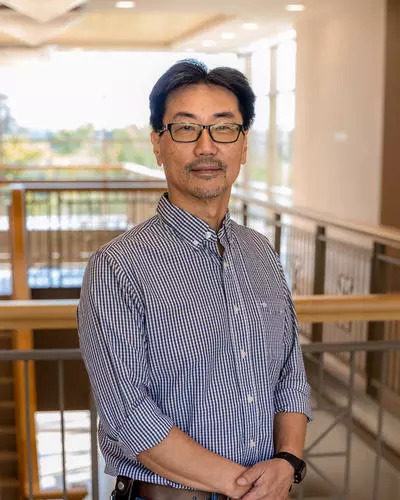
Some community members said Mu’s department could have been more proactive before the outbreak, imploring him to emphasize the importance of vaccination in public messaging.
“Clearly, when the situation was known to be coming into our communities, that would have been a time to advise for vaccines,” Steve Kahn told county supervisors at their February board meeting. “I think he was negligent in that.”
For years, public health has been a political flash point for the region. The Board of Supervisors fired the previous public health officer, Karen Ramstrom, in May 2022 after pushback from residents upset with her enforcement of state covid rules.
In an effort to reach vaccine-hesitant Californians, state officials have been working in a coalition called Public Health for All Californians Together and through an effort nicknamed Project Stethoscope that uses social media monitoring and other research to tailor messaging to skeptical viewers.
Erica Pan, director of the California Department of Public Health, said the state is preparing for measles to possibly surge when it hosts World Cup soccer matches starting in June, as well as with increased summer travel.
But when it comes to mitigating an outbreak in a community, public health officials say, residents — especially those skeptical of vaccines — need to hear from the people they know.
“Trust is very important for us,” Mu said. “It is critical in getting people to follow our guidance, especially during an outbreak.”
