






The National Center for Resources and Resilience (Cn2r) offers a clinical summary sheet on the developmental impacts of complex post-traumatic stress syndrome (PTSD-C) in children and adolescents. It highlights the seven areas which make it possible to establish a prism to evaluate this impact.
According to the ICD-11 (2025), complex post-traumatic stress disorder (PTSD-C) is characterized by the symptoms of post-traumatic stress disorder (PTSD): reliving, avoidance, feeling of threat associated with lasting disturbances in emotional regulation, self-image and interpersonal relationships, linked to prolonged or repeated trauma.
The diagnosis does not take into account the developmental impacts in the child. However, children exposed to abuse, family violence or the loss of their attachment figures often meet the criteria for several diagnoses: Depression – Attention Deficit Disorder (ADHD) – Oppositional Defiant Disorder (ODD) – Conduct Disorders – Eating Disorders – Sleep Disorders – Communication Disorders – Separation Anxiety Disorder – Anxiety Disorders – Reactive Attachment Disorder. Each of these diagnoses captures a limited aspect of the traumatized child’s complex self-regulation and relationship deficits.
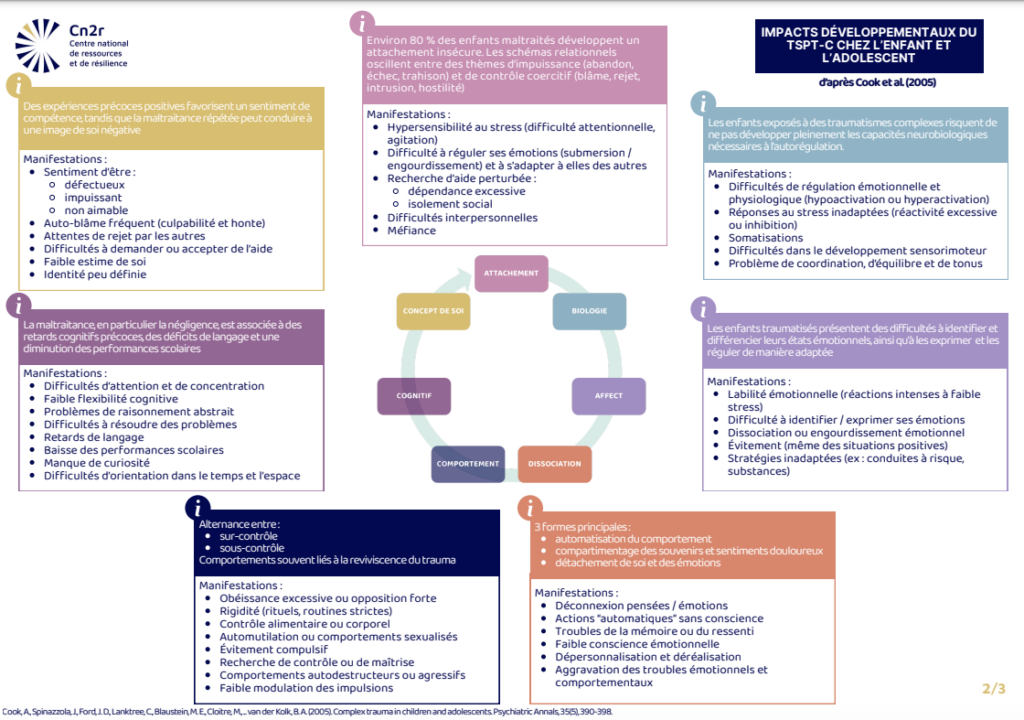
This literature review on C-PTSD suggests 7 main areas of consequences observed in children and to be found in this diagram:
It appears from this literature review (Cool et al. 2005) that the developmental impacts of C-PTSD in children and adolescents are as follows (to be found in the image below)

What are the essential components of intervention in cases of complex trauma in children and adolescents:
– security ;
– self-regulation;
– self-reflexive information processing;
– integration of traumatic experiences;
– relational commitment;
– improvement in positive affect;
Things to remember are: :
– the approach must be progressive (security then integration);
– several dimensions will be worked simultaneously;
– the components rely on each other;
– the process is not linear;
– the approach is necessarily global (body, emotion, cognition, relationships).
• Cook,A.,Spinazzola,J.,Ford,J.D.,Lanktree,C.,Blaustein,M.E.,Cloitre,M., …vanderKolk,B.A.(2005). Complex trauma in children and adolescents. PsychiatricAnnals,35(5),390-398.
• Resource: “ What is trauma? // Episode 1: the event – psychotrauma explained to children« – Cn2r
• Access the sheet Developmental impacts of C-PTSD in children and adolescents, Cn2r, (PDF)


