





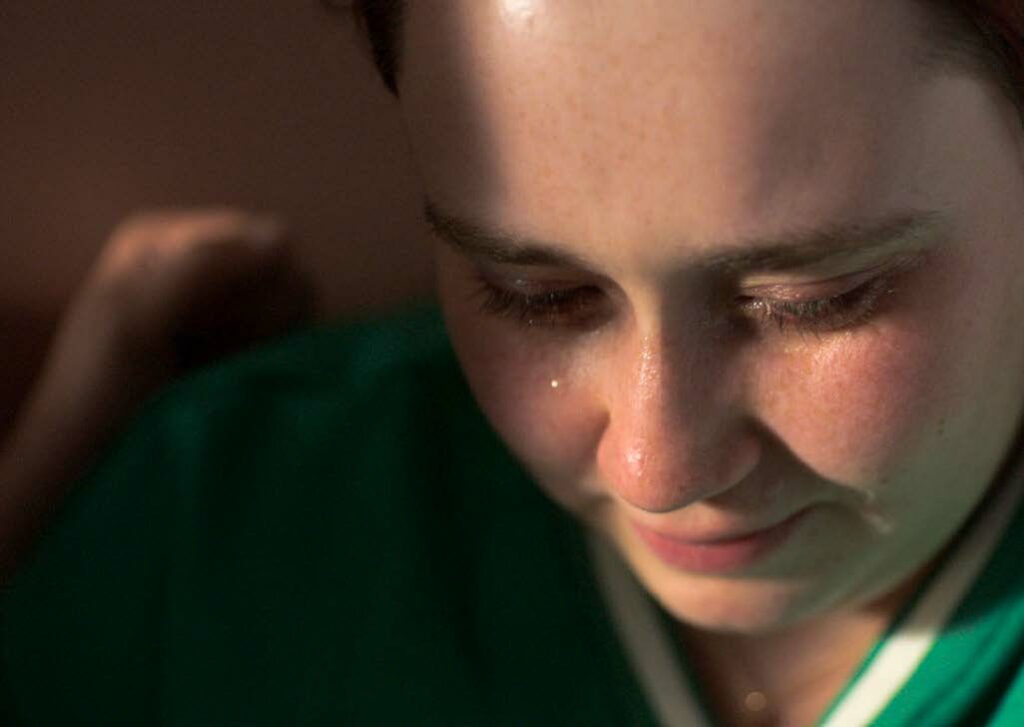
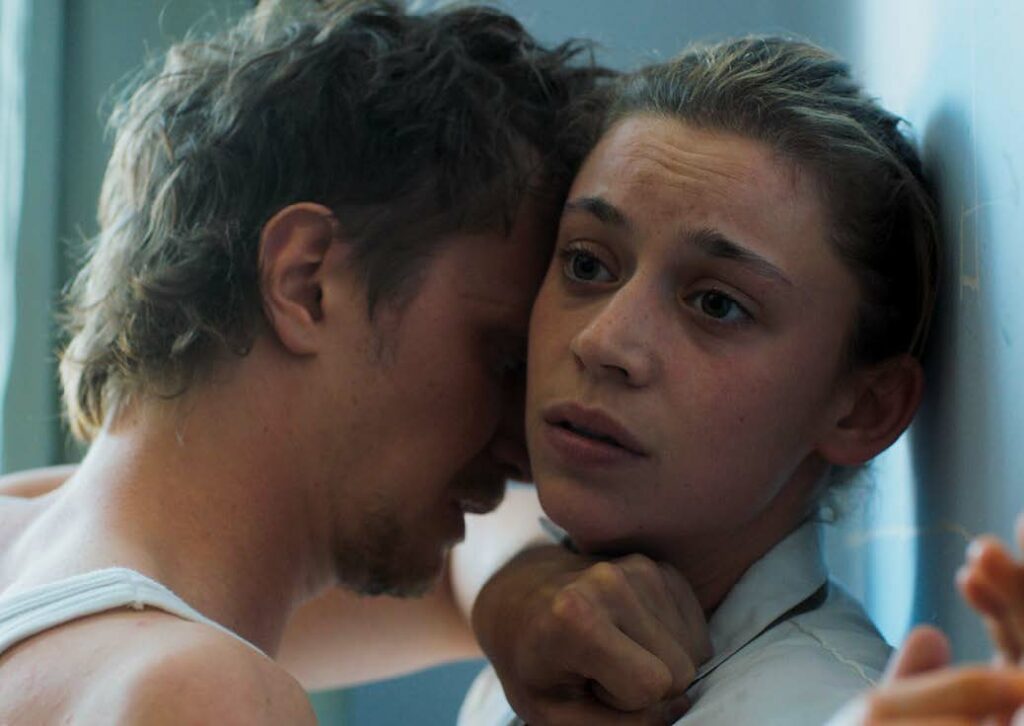
Alexia, a young trainee nurse, discovers a closed psychiatric ward where the rules impose distance, but where humanity falters at every moment. Through his relationship with Mila, a patient revolted by her confinement, At the edge of the world explores the tensions between care and constraint, commitment and protection. Nourished by field experiences and anchored in the contemporary realities of psychiatry, the film questions without judging. In theaters June 3, 2026
Alexia, 25 years old, strong-willed and idealistic, arrives as a trainee nurse in the closed ward of a psychiatric hospital. Despite warnings from Joëlle, the head nurse, about keeping a distance from patients, Alexia will get closer to Mila, a 20-year-old patient, who does not understand what she is doing there. Touched by her anger, Alexia will question the institution…
Interview
How was “At the Edge of the World” born?
The desire to make this film was born from discussions with a mutual friend, a psychiatric nurse, who spoke to us about her work in a closed unit and the question of knowing how to remain human in a setting and working conditions that were sometimes very difficult. His testimony touched us deeply. This subject has been with us for a long time and we had the impression that it was urgent to talk about it today in this post-Covid period where the mental health of so many people, particularly young people, has been shaken and where structures are often unable to keep up.
Psychiatry was already part of our respective concerns. Guérin has featured marginal characters in all his films, seeking to define under what conditions we are part of society or not, how we cope when we are excluded, and how moral questions arise then. Sophie is a psychologist, author and director. After several years of work in a psychiatric hospital in Armenia, she founded the troupe “L’Appétit des Indigestes”, for which she writes and directs shows around madness and normality with people with psychiatric experience, and she supervises mental health teams. His journey anchors him in a concrete knowledge of the human and institutional realities that the film goes through.
It was while attending one of his shows that Guérin suggested to Sophie that they write a film together. While writing, Guérin went into immersion in the closed unit of a psychiatric ward. This experience nourished the scenario and strengthened its anchoring in reality. The more the writing progressed, the more questions of production arose, and it was therefore natural that we embarked on directing together. The film was built in a constant dialogue. Our paths are different, but no decision was made alone. There was a real circulation of ideas, a common search for accuracy. This complementarity nourished the film at all stages: writing, preparation, filming and post-production.
Why did you choose a closed-door sequence shot?
We wanted to make people feel the violence of being locked up against one’s will for reasons that can sometimes seem obscure, and depend on a certain subjectivity of psychiatrists and judges.
The choice of sequence shots was imposed on us very early in the writing. We wanted to put the viewer in the shoes of Alexia, our young nurse, to follow her as closely as possible, and not to leave her side in one step so that the film is also a physical experience, that it has something carnal. We also wanted to make the viewer feel the stretching of time as it can be experienced in psychiatry. Furthermore, working in sequence shots with the actors is close to theatrical work, each shot becomes a challenge to overcome because they must be accurate from start to finish, there is no cutting to make up for their mistakes. This creates a tension and fragility in the actors that is valuable for the film because it echoed what their characters were experiencing.
What did you want to show about psychiatry?
We wanted to make a film that asks questions more than it gives answers. What interested us was the complexity of the issues. We wanted to create characters who do their best among both patients and caregivers but within an institutional framework that does not prevent violence from occurring. We wanted the viewer to be able to form their own idea of the correct reactions to have in different situations. Caregivers are caught in a demanding institutional framework. Some patients experience the most difficult moments of their lives. In these circumstances how can we preserve the dignity of each person? How much can you commit without getting lost? How can you support someone when they don’t want to be helped? The film opens these questions without trying to resolve them. It explores the gray areas: between protection and constraint, personal commitment and professional responsibility.
What is your view on the current state of psychiatry in Belgium and France?
Services are currently under pressure: lack of resources, institutional pressure, team fatigue. This makes everyday dilemmas even more complex.
But we also met deeply committed professionals, who seek to preserve the humanity of care despite the constraints. The film does not propose a political solution, but it reminds us of the importance of working towards this humanity.
What do you want the viewer to take away with them?
We didn’t want to make a film with a message. We wanted to question ways of working to invite the viewer to think, and create a sensitive experience, which changes the way we look at things, which allows us to see people who are often stigmatized differently.
If the viewer comes away with a slightly different, slightly more nuanced view of fragility, their own and that of others, then the film will have found its place.
Institutional Psychotherapy
Presentation and historical context
Institutional psychotherapy is a current of psychiatry and psychoanalysis born in France in the 1940s-1950s. She considers that care does not only concern the patient, but the entire institution in which he or she operates.
The term institutional psychotherapy was created in 1952 by the French psychiatrist Georges Daumezon. The movement was born in the context of the Second World War, in reaction to the alarming and dehumanizing reception conditions of patients in psychiatric hospitals.
Institutional psychotherapy emphasizes group dynamics and the relationship between caregivers and patients. Its major representative figures are the psychiatrists François Tosquelles, Jean Oury and Félix Guattari.
Fundamental concepts
Institutional psychotherapy starts from the principle that the institution itself can be caring or pathogenic, and that institutional dysfunctions (rigid hierarchy, absence of speech, isolation) can aggravate the psychological suffering of patients. Therapy therefore consists of transforming collective functioning to allow the subject to find a place again.
Take care of the institution
In response to the concentration camp conditions of the psychiatric asylums of the time, it is a question of modifying the institution, the structure of the establishment, to modify the relationships between caregivers and those being treated. The institution is integrated into the treatment and ceases to be reduced to a place of care and confinement to become a place which provides a living space, without denying the specificity of madness.
The institution as conceived by Tosquelles, Oury and institutional psychotherapy, aims to transform a fixed establishment to reintroduce meaning, desire and connection. It has a critical and caring function, capable of dealing with the establishment itself when it becomes alienating or purely managerial.
The collective as a therapeutic tool
According to the perspective of institutional psychotherapy, the hospital cannot function if it is content with a statutory, administrative and vertical hierarchy: this must be coupled with a subjective, mobile hierarchy, based on the plurality of transfers and shared speech. Meetings, the free circulation of speech and transversality make it possible to thwart the deadly effects of power, the interchangeability of caregivers and institutional entropy. Authority does not disappear, but moves: it protects the clinical space against managerial logic. Thus, hospital relationships become a care provider in their own right, and not a simple organizational setting.
GUERIN VAN DE VORST est un réalisateur belge, né en 1978 à Bruxelles, de parents comédiens. Il a commencé des études de philosophie à l’Université Libre de Bruxelles (ULB) avant de rentrer dans une école de cinéma (l’Institut des Arts de Diffusion – IAD) dont il est sorti diplômé de la section réalisation cinéma. Ses films mettent en scène des personnages marginaux, qui luttent pour essayer de se trouver une place dans le monde. Son dernier film Au bord du monde a été sélectionné au festival de Mar del Plata en 2024, où il a remporté le Grand Prix et le Prix de la meilleure interprétation pour Mara Taquin.SOPHIE MUSELLE est une réalisatrice, scénariste et metteuse en scène belge, née à Liège en 1974. Formée en psychologie et en théâtre, elle développe un parcours atypique entre art et soin. Son travail, nourri par des missions humanitaires au Chili, en Arménie et au Rwanda, interroge les frontières entre folie et normalité. En 2013, elle fonde la compagnie L’Appétit des Indigestes, pour laquelle elle écrit et met en scène des spectacles questionnant les normes sociales et la place des personnes dites « folles » dans la société. Elle porte ce regard au cinéma avec Au bord du monde, co-réalisé avec Guérin van de Vorst, sélectionné au Festival de Mar del Plata en 2024, où le film a remporté le Grand Prix ainsi que le Prix de la meilleure interprétation pour Mara Taquin.
• At the Edge of the World, a film by Guérin Van De Vorst and Sophie Muselle, produced by Wrong men, in theaters on June 3, 2026, documentary genre, France, 2026, 105 min.


