





Nurse Crystal Dhooghe is used to dealing with blood and broken bones in the emergency room. But she didn’t expect to witness so much violence against her own colleagues.
“I’ve seen nurses get shoved, pushed, scratched. The biggest one is bitten,” said Dhooghe, who works at Henry Ford Genesys Hospital in Grand Blanc, Michigan.
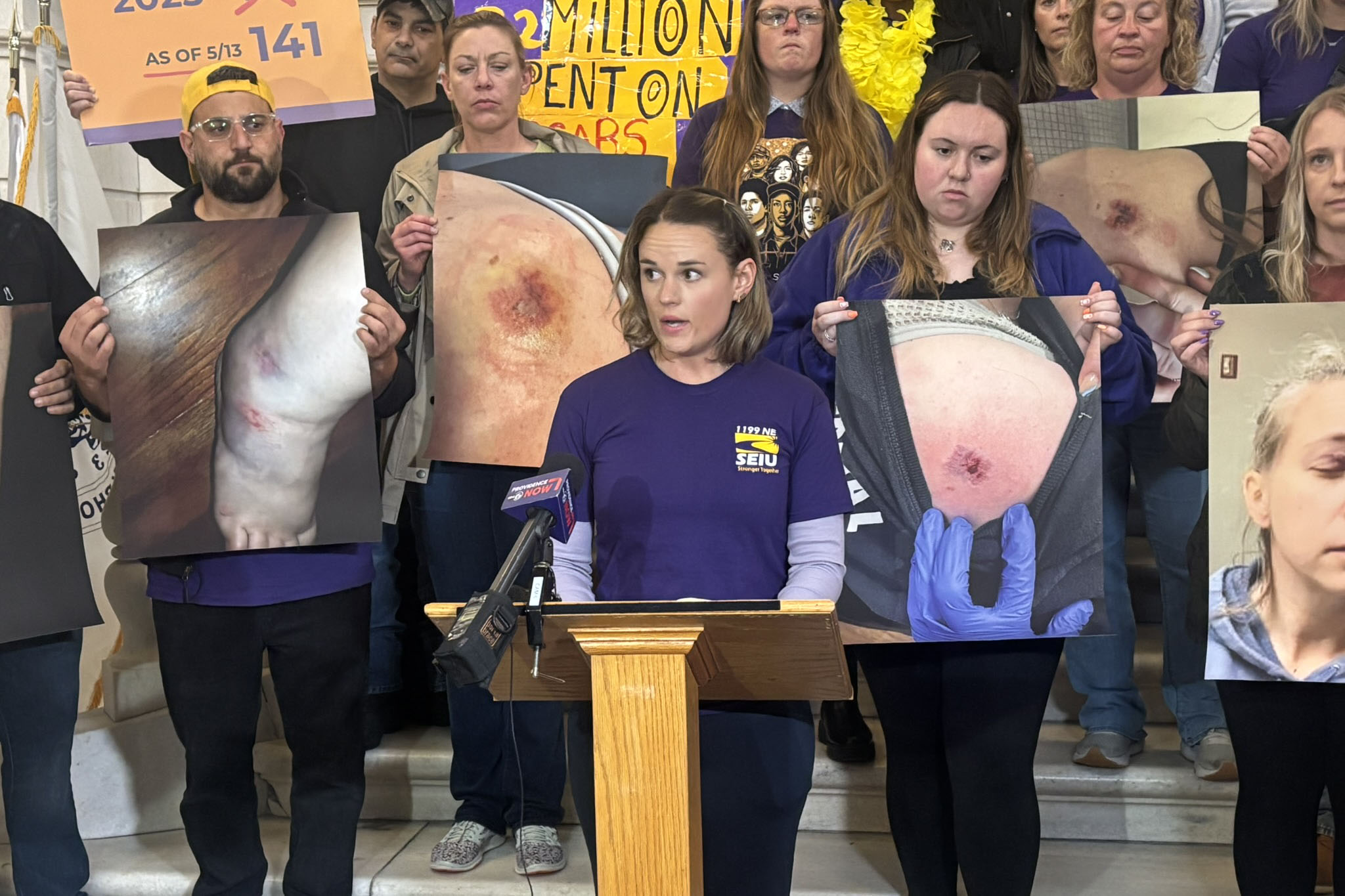
The prevalence of workplace violence in healthcare has fueled strikes in states such as Louisiana, New York, Pennsylvania, Rhode Island, and Michigan, where Dhooghe and many of her co-workers have been on the picket line since Labor Day last year.
“People will question me and be like, ‘Why are you still working in a place if you’re treated like this?’” said Dhooghe, who gets by on strike benefits and working extra shifts at another hospital. The problem, she said, is that other hospitals aren’t any better. “It’s the same everywhere I go.”
In a statement, Henry Ford Health spokesperson Dana Jay acknowledged violence against healthcare workers is a “national epidemic” and said the health system’s efforts to address the problem include metal detectors, armed security officers trained to make “misdemeanor arrests,” and de-escalation training.
“We have zero tolerance for violence of any kind,” said Jay, asserting the strike is not about safety but is instead “simply an economic strike.”
Nationwide, hospital workers are seven times as likely to be injured on the job due to violent acts as members of the general working population, according to the most recent data available from the Bureau of Labor Statistics. The outcry over workplace violence in healthcare is pitting workers’ demands for better compensation and staffing against hospital operators pressured to cut costs.
‘A Powder Keg’
Violent outbursts are so common that they’ve been dramatized on the popular medical TV series The Pitt. “Emergency rooms right now are like a powder keg,” said Rachel Odes, an assistant professor at the University of Wisconsin-Madison School of Nursing.
In hospitals, a combative or violent patient is known as a “code gray.” Outbursts can be spontaneous and unpredictable, making some almost impossible to prevent. But research shows the risk of violence increases when hospitals are understaffed or employees are insufficiently trained or experienced.
Mental health worker Andrew Kimball-Mirzaie said he got hurt in February 2024 at Butler Hospital in Providence, Rhode Island.
He’d been working at the private psychiatric hospital for about six weeks and said he hadn’t yet worked in the ER. He said he was sent there to “monitor” a man in his 20s who was waiting for an inpatient bed.
The patient was alone in a back room watching a Knicks basketball game on TV, he recalled. Kimball-Mirzaie said he got the patient a drink and a snack. They were watching the game when, suddenly, he said, the patient stood up and punched him in the face. He said the assault left him with a concussion and broken nose. His injuries were documented in the hospital’s incident log.
“I understand that there is an inherent danger with the job,” Kimball-Mirzaie said. He doesn’t blame the patient, who was very ill at the time. “We should have had at least another staff member with us,” he said, “and I should have been adequately trained on the unit.”
The attack emboldened Kimball-Mirzaie to join some 700 other unionized Butler workers last spring and summer in a months-long strike, which forced the hospital to close nearly half of its beds. Service Employees International Union 1199 New England declared the strike a win.
Employees received wage increases that union leaders said would enable the hospital to attract and retain more staff. The hospital also agreed to provide financial support for workers violently injured on the job. And the hospital and union agreed to jointly fund a “time bank” to supplement workers’ compensation for injured workers who need more time to recover.
But five months later, a nurse supervisor at Butler had to call 911 because an unarmed patient in the hospital’s ER was assaulting staff. According to the police report, by the time police arrested the patient, he’d injured two nurses, a security guard, and a police officer.
“Butler recognizes the importance of being proactive in protecting those who provide care,” Mary Marran, Butler’s president and chief operating officer, said in a statement. She added that hospital leadership meets regularly with staff to review safety measures and “identify opportunities to strengthen protection for everyone.”
The patient was charged with four counts of felony assault, including against the two nurses.
The American Hospital Association has said punishment is key to preventing violence. It has been lobbying Congress to make assaulting healthcare workers a federal crime that would carry up to 10 years in prison. At least 45 states, including Michigan and Rhode Island, have enacted similar laws. But workplace safety experts say there is no evidence that such laws have reduced the incidence of violence against healthcare workers.
Calls for ‘Safe Staffing’
Striking healthcare workers around the country often have demanded “safe staffing” instead of stronger punishments for patients who cause injuries.
The rise in violence against healthcare workers has caught the attention of the Joint Commission, the accreditation organization for more than 80% of U.S. hospitals and health systems. The commission released national performance goals that took effect in January and require hospitals to be properly staffed and that staff be trained “to provide safe, quality care.”
But no federal law limits the number of patients in a nurse’s care across healthcare settings, despite the nation’s largest nurses union, National Nurses United, having pressed for a national standard since 2018. Hospitals must “safely staff all units” to enable nurses to “provide the care that patients need before they get agitated or disoriented,” said Jane Thomason, lead industrial hygienist for National Nurses United.
Some states have passed their own staffing laws. Only California has enacted broad mandatory nurse staffing ratios, which research shows were associated with lower mortality rates and likely higher retention. Oregon enacted a staffing law, with exceptions. Legislators in Massachusetts and New Jersey have introduced similar bills, but they have failed to advance to floor votes.
The American Hospital Association opposes mandatory minimum nurse staffing ratios in hospitals, saying they would “remove real-time clinical judgment and flexibility,” compound staffing shortages, and potentially force some hospitals to turn away patients or delay care, spokesperson Colleen Kincaid said. And she pointed to California, whose new emergency nurse staffing ratios for psychiatric hospitals reportedly forced bed closures in at least four counties.
“There are a lot of other things you can do to prevent workplace violence than just increasing staffing levels,” said Jordan Barab, who was a deputy assistant secretary of labor for the Occupational Safety and Health Administration during the Obama administration and helped develop OSHA’s 2016 guidelines for healthcare and social service workers.
Barab said hospitals can, for example, train employees in de-escalation, install metal detectors, or have specially trained security guards on-site so staff don’t have to wait for police to arrive when an incident happens.
Debbie Berkowitz, a worker safety and health policy expert at Georgetown University, said the health provisions in congressional Republicans’ One Big Beautiful Bill Act will squeeze hospitals’ budgets in the next few years.
When funding dries up, she said, “protecting workers is going to be the first thing that gets cut.”
This article is from a partnership that includes NPR and KFF Health News.