





After a grueling year of chemotherapy, surgery, and radiation to treat breast cancer, Sadia Zapp was anxious — not the manageable hum that had long been part of her life, but something deeper, more distracting.
“Every little ache, like my knee hurts,” she said, made her worry that “this is the end of the road for me.”
So Zapp, a 40-year-old communications director in New York, became one of millions of Americans to start taking an anxiety medication in recent years. For her, it was the serotonin-boosting drug Lexapro.
“I love it. It’s been great,” she said. “It’s really helped me manage.”
The proportion of American adults who took anxiety medications jumped from 11.7% in 2019 to 14.3% in 2024, with most of the increase occurring during the covid pandemic, according to survey data from the Centers for Disease Control and Prevention. That’s 8 million more people, bringing the total to roughly 38 million, with sharp increases among young adults, people with a college degree, and adults who identify as LGBTQ+.
Even as psychiatric medications gain public acceptance and become easier to access through telehealth appointments, the rise of a class of antidepressants called selective serotonin reuptake inhibitors, known as SSRIs, has triggered a backlash from supporters of the “Make America Healthy Again” movement who argue they are harmful. Doctors and researchers say medications such as Prozac, Zoloft, and Lexapro are front-line treatments for many anxiety disorders, including generalized anxiety disorder and panic disorder, and are being misrepresented as addictive and broadly harmful even though they’ve been proved safe for extended use.
Health and Human Services Secretary Robert F. Kennedy Jr. has decried broadening SSRI use. During his Jan. 29 confirmation hearing, he said he knows people, including family members, who had a tougher time quitting SSRIs than people have quitting heroin. More recently, he said his agency is studying a possible link between the use of SSRIs and other psychiatric medications and violent behavior like school shootings.
Food and Drug Administration Commissioner Marty Makary has also suggested that SSRI use among pregnant women could lead to poor birth outcomes.
SSRIs’ common side effects include upset stomach, brain fog, and fatigue. Some SSRIs also can reduce libido and cause other sexual side effects.
For many people, however, the side effects are mild and tolerable and the benefits of treating chronic anxiety are worth it, said Patrick Kelly, president of the Southern California Psychiatric Society. “The statements about SSRIs were just not grounded in any sort of evidence or fact,” Kelly said of Kennedy’s comments.
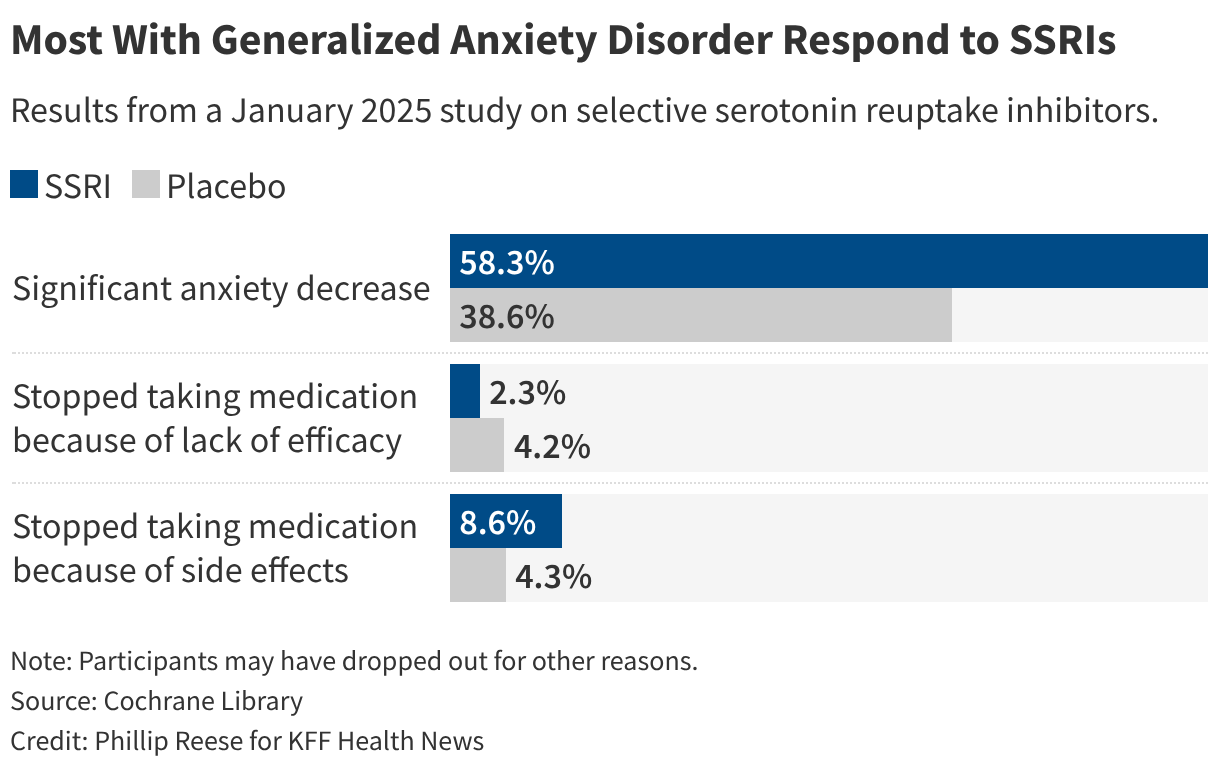
A recent comprehensive study showed that over half of people with generalized anxiety disorder taking an SSRI saw their anxiety symptoms reduced by at least 50%. Side effects prompted about 1 in 12 to stop taking an SSRI.
“When it’s being done right and when you’re also using appropriate therapy techniques, SSRIs can be really, really helpful,” said Emily Wood, a psychiatrist who practices in Los Angeles.
MAHA Blames Anxiety on Poor Diet, Lack of Exercise
Supporters of MAHA have partly blamed poor dietary choices and the increase of a sedentary lifestyle for the rise of a number of health problems, including anxiety, depression, and other mental health disorders. As a remedy, they have called for measures such as reducing consumption of ultraprocessed foods, which studies in recent years have connected to depression and anxiety, and cutting back on screen time in favor of exercise.
Psychiatrists often encourage a healthy diet and exercise as an adjunctive therapy for anxiety and depression. Wood said those who can manage anxiety without medication should also consider talk therapy. The proportion of American adults using mental health counseling boomed from 2019 to 2024 as teletherapy grew in popularity, federal data shows. “Anxiety disorders are amongst our psychiatric disorders that really respond well to cognitive behavioral therapy,” she said.
But medication can help.
Studies show the risks of taking SSRIs during pregnancy are low for mother and child. By contrast, “depression increases your risk for every complication for a mother and a baby,” Wood said, adding that recent statements by government officials about SSRI use during pregnancy are “potentially leading to real harm for these women.”
Some people who stop taking antidepressant medication will experience nausea, insomnia, or other symptoms, especially if they quit suddenly. But “the concept of addiction simply does not apply to these chemicals,” Kelly said, a statement backed up by studies.

Addiction, though, is a possibility with benzodiazepines such as Xanax that are often a second line of treatment for anxiety. These controlled substances can also increase the risk of opioid overdose in patients taking both types of drugs. During congressional hearings last year, Kennedy also decried benzodiazepine overuse as a problem.
While benzodiazepines are effective for short-term use, they require monitoring and care, Wood said.
“Those are really great meds for acute anxiety and not great as long-term anxiety medications, because they are habit-forming over time,” Wood said. “If you’re taking them on a daily basis, you’ll need more and more to get the same effect, and then you have to come down from them in a tapered way.”
And an increasing number of people are also occasionally taking beta-blockers such as propranolol for anxiety. Some people use beta-blockers to prevent a racing heart before a public speech or other big moments, even though they are not FDA-approved for treating anxiety and are prescribed “off-label.”
Beta-blockers can cause dizziness and fatigue, but they are “nonaddictive, really helpful for bringing down the autonomic nervous system, going from fight or flight to something more neutral, and really safe,” Wood said.
Social Shifts Drive Increased Use of Anxiety Meds
A number of leading theories could explain why so many more people are taking anxiety medication, including increased social media use, more isolation, and heightened economic uncertainty, physicians and researchers say.
Plus, the medicines are relatively easy to get. Many people obtain SSRI and benzodiazepine prescriptions from their primary care physician. Others obtain the medications after a brief teletherapy appointment.
Many social media influencers talk about their mental health struggles, easing some stigma among young people and encouraging them to get help. About a third of teens in a recent study said they get mental health information via social media.
Still, increased access to anxiety medication can be a problem when combined with a trend of self-diagnosis based on social media trends. A Google search for “buy Xanax online” leads to sponsored promises of same-day treatment, though fine-print disclaimers clarify that a prescription is not guaranteed.
“I think increased access is good, but that’s not the same thing as, you know, ordering Xanax online,” Kelly said.
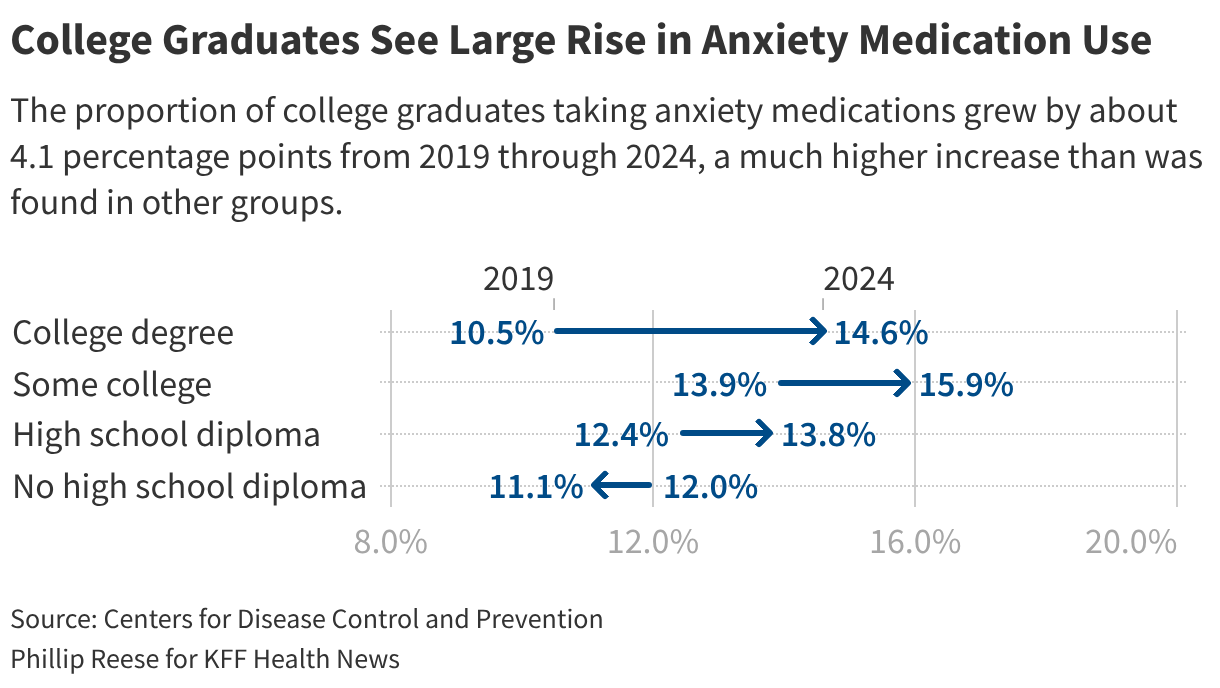
Young adults are largely driving an increase in anxiety medication use. The proportion of Americans ages 18 to 34 taking anxiety medication rose from 8.8% in 2019 — the first year such survey data became available — to 14.6% in 2024. By contrast, the rate didn’t change much among adults 65 and older, CDC data shows.
The pandemic and covid lockdowns greatly increased stress among many American adults, particularly young adults.
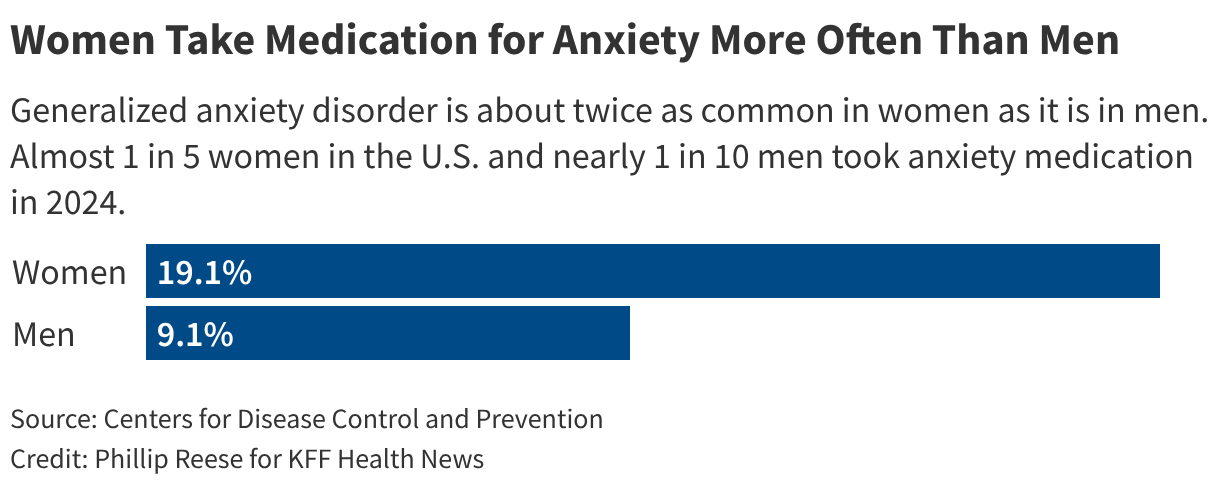
And data shows more women than men take anxiety medication. Jason Schnittker, a department chair and professor of sociology at the University of Pennsylvania, said that’s because they’re more likely to need them. They are also likelier than men to report when they feel anxious, and doctors are “inclined or see anxiety more readily in their female patients than their male patients,” Schnittker added.
Broader trends could also be at work. Schnittker said studies have shown anxiety growing more prevalent among ensuing generations for much of the 20th and 21st centuries. Schnittker, author of Unnerved: Anxiety, Social Change, and the Transformation of Modern Mental Health, said growing income inequality could be partly to blame, with people feeling stress over improving their economic status. Social and religious activities have been replaced by more isolation. And people have become more suspicious of others, creating a sense of unease around strangers.
For Zapp, the cancer survivor, it took a few months on Lexapro before she started seeing clear results. When she did, she said, it felt like her mind was less noisy, making it easier to focus. She also underwent talk therapy, but now her chronic anxiety is stabilized on medication alone.
“It definitely helped me get back to my day-to-day in a way that was productive and not just riddled with my anxieties throughout the day,” she said.
KFF Health News’ Holly Hacker, Maia Rosenfeld, and Lydia Zuraw contributed to this report.

