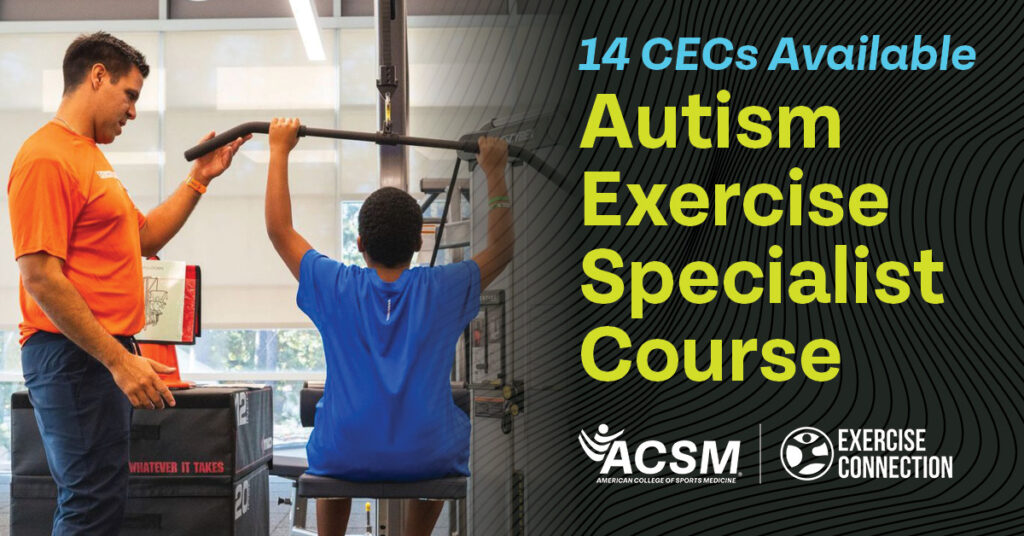
Exercise is one of the most effective tools for improving physical and mental health, yet autistic individuals remain one of the most underserved populations in physical activity settings. Autism is a neurodevelopmental disorder that includes deficits in sensory and communication skills, and restricted and repetitive patterns of behavior and/or activities. Despite the well-established benefits of exercise, the current reality is autistic individuals engage in significantly less regular physical activity and sport participation than neurotypical peers. However, exercise participation can mitigate certain challenges that autistic individuals can experience, such as motor and social skills. Decades of research have highlighted exercise as a powerful tool for improving health, yet exercise environments have been slow to evolve in ways that meaningfully accommodate autistic individuals.
Barriers to Exercise Participation
Autistic individuals face multi-faceted barriers to exercise participation, including those of the individual-level such as sensory sensitivities (e.g., noise, lights, crowded environments), motor coordination difficulties, social communication challenges in group sports, and preference for routines and resistance to unfamiliar activities. Environmental and systemic barriers also must also be considered, like the lack of autism-friendly exercise programs, inadequate inclusive policies in schools and community recreation, limited access to trained professionals, and caregiver and financial burdens. Social factors are critical factors, given autistic individuals often experience bullying or exclusion in sports and recreation, limited peer support, and the impact of pervasive stigma and misconceptions about autism and physical capability. What’s more, the transition to adulthood is a pivotal time when autistic individuals encounter major reductions in structured physical activity after the school years and few adult-centered adaptive fitness opportunities.
Calls to Action
Several steps are desperately needed to promote and increase physical activity participation within this underserved population.
- Firstincreased accessibility and inclusion is sorely needed. The development of sensory-friendly and autism-adapted exercise programs, including improved accessibility in schools, gyms, and community centers should be a priority.
- Secondtraining fitness professionals, physical educators, and healthcare providers in autism-inclusive practices is essential. Encouraging interdisciplinary collaboration among these professionals will likely help achieve greater levels of success.
- Thirdproviding caregiver education and support systems for families of autistic individuals is essential. Promoting affordable and inclusive community recreation initiatives can help significantly reduce the caregiver and financial burdens.
- Fourthpolicy and public health initiatives should be unabashedly championed, starting with increased funding for adaptive physical activity programs. This includes incorporating strategies based on autism treatment approaches, such as Applied Behavior Analysis, that can help identify environmental or behavioral factors that interfere with exercise. These calls to action represent a comprehensive starting point (and certainly not an exhaustive list) that can begin to increase and support exercise participation in autistic individuals.
Other Considerations
Some technologies, like virtual reality (VR), can encourage exercise participation in this population. VR is an immersive, 3D environment that can offer controlled sensory environments, gamified and motivating exercise experiences, and even opportunities for social skills training and motor development. Emerging research suggest VR-based exercise may improve enjoyment, motivation, and exertion. VR can also be used in the comfort of one’s home, opening up the potential for individualized and home-based exercise participation. Telehealth exercise programs, wearable technology, and online coaching can further distribute exercise participation in this population, especially for those who live in rural communities. Using these devices can help make exercise accessible for autistic individuals by acknowledging their needs, strengths, and lived experiences.
Future efforts to increase exercise participation among autistic individuals that extend beyond technological innovations should include participatory co-design. Instead of designing exercise programs for autistic individuals, researchers can create exercise plans with autistic individuals through community-based participatory research or co-design workshops. Rather than adapting autistic individuals to existing programs, future efforts should focus on designing exercise environments around autistic needs from the start. Providing predictable routines, reducing sensory overload, and offering clear visual supports and instruction can increase exercise motivation and long-term adherence. Exercise participation is often constrained, not by autistic characteristics, but rather by environments that overlook the preferences and experiences of autistic individuals.
Amanda K. McMahon, PhD, is an assistant professor and the director of the Digital Mind and Motion Laboratory within the Department of Kinesiology and Educational Psychology at Washington State University. Her main research interests are promoting overall health and wellbeing through the use of technology devices in college students with and without disabilities.