





U.S. health secretary Robert F. Kennedy Jr. is pursuing federal government access to most Americans’ medical records, in a quest to research a link between vaccines and autism — a connection the medical establishment studied for decades and flatly rejects.
The Department of Health and Human Services is seeking data from little-known state systems that allow hospitals and clinics to exchange detailed, identifiable patient information, KFF Health News has learned.
In private meetings, some public health leaders have objected to giving Kennedy’s team access to such data, raising doubts that it’s legal or that the information would even be useful.
They have also expressed concerns about allowing the federal government to peer into the minutiae of Americans’ medical records, which could mean viewing anything from doctors’ notes to prescription history. HHS has offered no insight into how it will protect or handle the personal health information it obtains.
But Kennedy told KFF Health News that medical records are key to investigating the cause of autism, vaccine safety, and chronic diseases. And millions of dollars in grant money has poured into a Nebraska nonprofit that has assisted Kennedy’s effort, according to state records.
He and his advisers have been frustrated that federal access to Americans’ medical records has been limited.
“We need a good health record system, and one of the things that really surprised me most when I came into office is that there is — that the systems are broken,” Kennedy said in a May interview. “We’ve had to go to the states and, luckily, we’ve got a lot of cooperation from the states, but we now have databases together that we can actually do the studies on. Those studies are in motion.”
HHS has not publicly announced any new projects involving medical records and autism or vaccine research. Kennedy faced blowback last year when he proposed compiling the medical records of people with autism to create a federal disease registry — which health department officials later disputed was underway.
But Kennedy said in May, “We have a whole pipeline of studies that will be done over the next year.”
Though the White House has steered Kennedy away from further changes to U.S. vaccine policy ahead of November’s crucial midterm elections, President Donald Trump has regularly echoed Kennedy’s doubts about vaccine safety and last week signed an executive order calling for the U.S. to reduce the number of vaccines recommended for children.
Kennedy’s political appointees and allies — including William “Reyn” Archer III, a former Texas health official and vaccine critic whom Kennedy hired as a senior adviser — have led the initiative for the health department to collect and examine medical records.
Federal officials met with leaders of the state-run health information exchange systems several times over the past year and asked how the personal medical records they maintain could be used for vaccine research, according to seven people who participated in the discussions or were familiar with them.
Craig Behm, who runs the Maryland health information exchange, said Kennedy’s team asked about how the vast trove of medical records they store from hospitals and health systems could be used to study vaccines.
“If this administration wants to conduct research on the effectiveness of vaccines, are you saying you all can help us conduct that research?” Behm recalled being asked by a top official at HHS’ health information technology office.
Last June, Behm and leaders of other state exchanges met with Kennedy’s top advisers to discuss sharing more medical data with federal agencies. The state organizations followed up with a pitch in October for a new surveillance system that would give the federal health department “real-time, 24-hour data feeds on opioid and chronic disease trends” within a year, according to a presentation reviewed by KFF Health News. Under the proposal, HHS would get data from 90% of the population’s medical records by 2028.
Administration officials regularly asked during the meetings how the records could be used to monitor vaccine safety. Kennedy has rejected the federal government’s current vaccine-monitoring systems; decades of research has shown immunizations are safe and effective for most people.
“Vaccine safety, or whatever words you want to use, has come up pretty consistently in those conversations,” said John Kansky, CEO of the Indiana Health Information Exchange.
Kansky sees the potential value of sharing information from the exchanges for public health but is worried about the focus on vaccines: “It’s like, oh man, I wish you would have picked something that pushed fewer buttons for people.”

A System To Monitor Chronic Disease
Nearly every state has at least one health information exchange — often regulated by state laws and run by private companies or nonprofits — that enables hospitals and health systems to immediately share patients’ medical records with one another. The systems allow doctors and nurses to quickly pull up nearly anyone’s medical history and records at emergency rooms or share after-visit summaries and notes with patients’ primary care providers, for example.
In certain circumstances — most often dealing with cases of infectious diseases such as measles or flu — the exchanges notify public health authorities, like the state health department or the Centers for Disease Control and Prevention. Using the exchanges for broader public health purposes is not an unusual idea in itself. But it can present privacy, legal, and ethical complications, health officials say.
In the end, Behm said his organization in Maryland declined to share more data with the federal government for vaccine research, noting that sharing medical records for that purpose would require a rash of approvals from hospitals, state political leaders, and research boards. Any new data-sharing agreement should also have a clear, detailed framework outlining what would be shared and with whom, he added.
“A number of us said, ‘We can’t do anything our agreements don’t allow us to do, so no,’” Behm said. Indeed, most health information exchanges have contractual restrictions on who can access clinical data.
Kansky said Indiana is still weighing whether to provide additional data for Kennedy’s project, and that nothing has yet been shared.
HHS spokesperson Emily Hilliard did not answer questions about how many states are participating in Kennedy’s project, what new data the agency is collecting, how much the federal government is spending on the initiative, how it is protecting patient privacy, or who has access to the data.
“HHS is strengthening public health surveillance and modernizing data systems to better understand and combat the childhood chronic disease epidemic as part of Secretary Kennedy’s Make America Healthy Again agenda,” Hilliard said in an emailed statement. “Americans deserve robust systems to monitor the drivers of chronic illness.”
Kennedy has asserted, without evidence, that vaccines can cause chronic illness.
A Kennedy Partner in Nebraska
At least one state has been cooperative.
The former leader of Nebraska’s state health information exchange has led the effort to share data from medical records with the federal government.
Jaime Bland, former CEO of CyncHealth — the Nebraska health information exchange used by most hospitals and health systems in the state — said several states are looking to “open up channels” to provide more analysis to Kennedy’s team.
“They’re looking at the data differently and providing some insights back to the CDC,” Bland told KFF Health News.
Bland was among a group who proposed that CyncHealth would help kick off the initiative, according to a 43-slide PowerPoint presented to federal officials during an October meeting.
CyncHealth and other state health information exchanges would “ingest data from hospitals, clinics, laboratories, pharmacies, payers, and social services agencies,” then “link claims and clinical records through a master patient index.”
Data from the exchanges “will be deidentified where appropriate,” according to one slide.
The federal government would pay the exchanges for furnishing the records, according to the proposal: $3 a person, annually.
Officials would “frame publicly that this is not a new database, but a federated trust model that delivers real-time data for all HHS missions,” the presentation reads.
After the meeting, Nebraska’s health department was awarded a large grant from the CDC, and CyncHealth in turn got millions of dollars from the state.
On Dec. 19, the CDC announced new funding under its Epidemiology and Laboratory Capacity program, which sends money to state and local health departments for lab work, health information enhancements, and solutions for outbreaks.
Nebraska’s state health department was awarded $18.7 million — the most of any state last year, though Nebraska is the 38th most populous state. By comparison, Texas received $9.2 million, and California got $10.8 million.
CyncHealth was then awarded three contracts totaling $13.6 million from the state health department just weeks later, on Jan. 9 and Jan. 16, according to a publicly accessible database of state contracts.
Grace McNamara, a spokesperson for CyncHealth, said it retained $2.4 million of the funding for Kennedy’s project; the remaining money was distributed to “other participating states and various vendor organizations for implementation support.”
A former CDC official who was aware of the transaction, but not authorized to speak publicly about it, confirmed the money was intended for CyncHealth to supply data for Kennedy’s initiative to look at vaccines and autism. McNamara said that the “work is focused on improving outcomes related to acute and chronic illnesses.”
“The referenced project is not research, but rather a proof-of-concept project on how health information exchange and public health can work together to improve health outcomes and is not specific to autism,” she said in an emailed statement.
McNamara did not answer questions about what type of medical data is being provided to the federal health department or whether patients’ identifying information is removed.
Bland left her post at CyncHealth — where she was paid nearly $420,000 a year — in December. She was named in April as the chief data strategist for the MAHA Institute — a think tank founded by allies of Kennedy and Trump to advance their Make America Healthy Again movement.
Bland agreed with Kennedy that data from state health information exchanges could provide more insight into autism’s causes or vaccine injuries.
“The data is so fragmented, so modeled when it comes to population health and public health, that we lose sight of the individual stories,” Bland said. She told a story she had heard about a woman who had a seizure after receiving the HPV vaccine.
“You know, the vaccine is safe — it absolutely is — but it wasn’t safe for her,” Bland said. “As public health officials, we say the vaccine is safe. But there are cases where it is not.”
Daniel Jernigan, a former top CDC official who left the agency last summer, said he tried to point Kennedy to data that would help the health secretary study vaccine safety and autism.
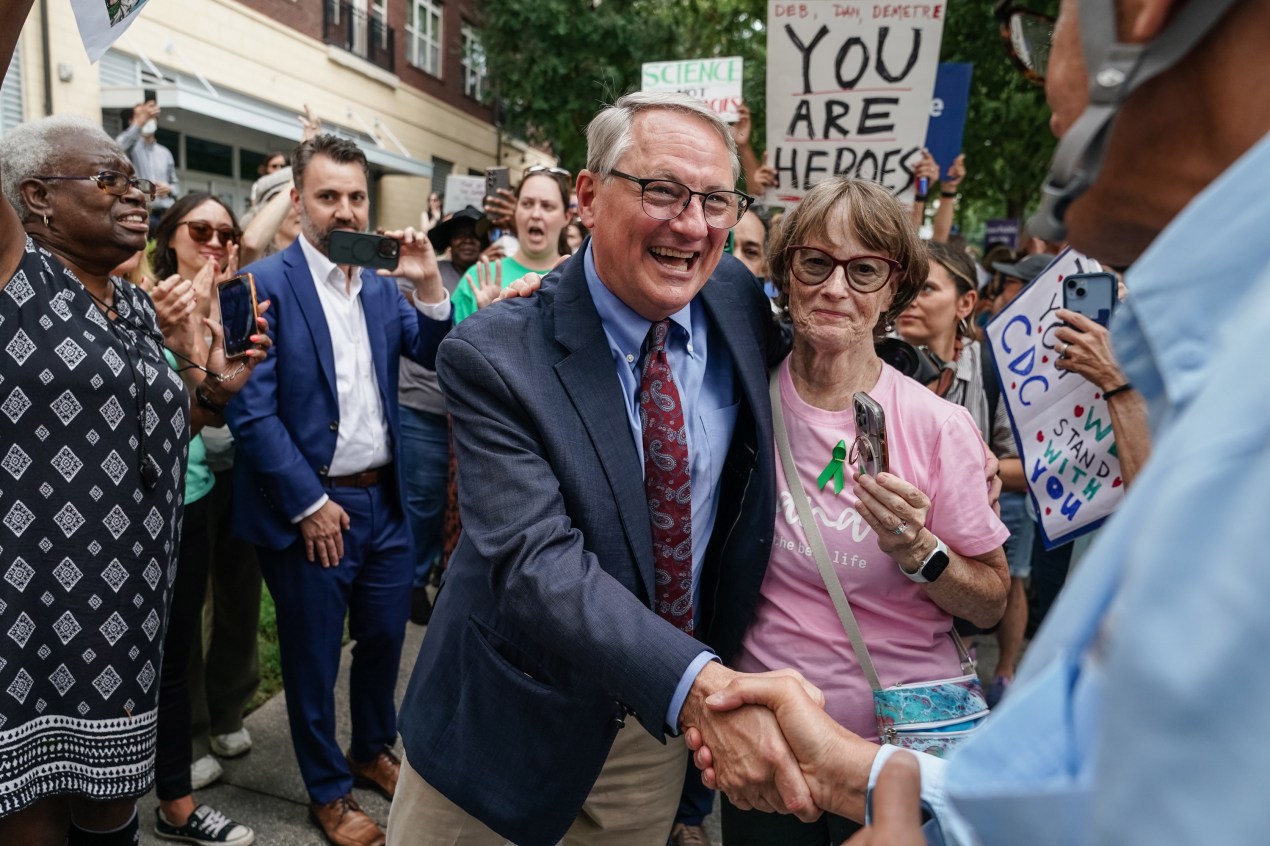
After 31 years at the CDC overseeing public health surveillance, emerging infectious diseases, and the influenza divisions, Jernigan thought the solution was simple. The secretary could work with researchers to obtain huge databases pulled from health systems nationwide and maintained by major electronic health records companies.
Those databases are deidentified, meaning they don’t include patient names or other information that can identify individuals. Jernigan said Kennedy didn’t seem interested.
Instead, as The New York Times first reported, the health secretary dispatched two top advisers — Archer and Hannah Anderson, his former deputy chief of staff — to the CDC’s headquarters in Atlanta last July to download millions of identifiable patient records directly from the Vaccine Safety Datalink, the system the health agency uses to investigate complications from vaccines. The records, though, were decades old.
Jernigan said the federal government has limited legal authority to access medical records from state health information exchanges. In any case, examining those records may provide a view of a person’s medical history that will not necessarily produce answers to Kennedy’s questions about vaccines and autism.
“If they’re just using the electronic health record data, there are limits to that,” Jernigan said. “If they’re only looking at electronic health record data, all you’re going to get is what was captured in the encounter. It’s not going to be very satisfying.”
KFF Health News data reporter Maia Rosenfeld contributed to this article.