





In its 2026 report on the application of Social Security financing laws, the Court of Auditors reveals that for a return to balance by 2030, it will be necessary to find 10 billion euros in savings or revenue each year. Make a deficit which doubled in two years to reach €21.6 billion, it makes 35 recommendations and advocates, among other things, an overhaul of the system of franchises and flat-rate contributions. Press release.
A degraded financial situation, room for maneuver to be reconstituted
The social security deficit has doubled in two years to reach €21.6 billion in 2025, a level slightly lower than that of the initial financing law but the highest since 2012 excluding exceptional covid years. The increase in revenue (2.6%) was lower than that of expenditure (3.6%) despite a significant contribution of new revenue.
In 2026, this deficit should decrease to €19.4 billion, due to of new revenues and transfers from the State more than savings in expenditure. However, the execution risks are significant, particularly due to the consequences of the current geopolitical crisis on growth and inflation. Even assuming, like the Government, the hypothesis of temporary and limited effects of this crisis, the Court estimates the risk on the deficit to be at least €3 billion in 2026 and €5 billion in 2027 before saving measures. For the futureand even before suffering the effects of this shock, the financing law for 2026 predicted a trajectory of increase in the deficit and debt, with long-term sustainability risks.. It is essential, to restore room for maneuver, to initiate an action plan now aimed at bringing the social security balance back to balance in 2030.
The national health insurance expenditure objective (ONDAM), passed every year as a financing law since 1996, no longer provides effective regulation since the health crisis. For him fulfill its role of strategic management of health spendingits multiannual framework should be strengthened and the transparency of its annual construction improved. Furthermore, the regulatory levers in execution should be rebalanced and strengthened: the objective was achieved in 2025, despite overruns on the sub-objective of community care for daily allowances and medication, thanks to €1.2 billion in savings in management of health and medico-social establishments.
Strengthening the rigor of accounting practices branches and national funds of the general social security system have been linked, for twenty years, with certification of their accounts by the Court. The number of significant accounting anomalies was reduced from 10 to 2 and the funds developed the measurement of their internal control and the incidence of fraud. The Court makes recommendations for improve the reliability of direct debits and payments, fraud detection and recovery of overdue amounts.
Reforms necessary to straighten out social accounts
- Flat-rate contributions and medical deductibles, owed by patients for numerous medical expenses (consultations, purchases of medicines, etc.) brought in €2.3 billion to the general social security regime in 2025. The Court recommendsimprove information for policyholders on the amounts they pay andincrease yield of these devices (€500 million through a reform of recovery procedures, €600 million through the removal of poorly justified exemptions). In the longer term, participations and franchises could be merged and the level of income taken into account.
- The Court analyzed dental care reforms since 2018 (annual examinations covered for 3-24 year olds, upgrading of conservative care, 100% health). She noticed a continued increase in spending (€15.7 billion in 2024) and fees of practitioners, in particular orthodontists, as well as the increase in territorial inequalities in access to dental care. It recommends improving the effectiveness of controls, strengthening restrictions on installation in well-endowed areas, and better regulating expenses for prosthetic and orthodontic care.
- Land transport of patients outside of emergencies can be provided by ambulance, light medical vehicle, approved taxi, or by the patient himself. To reduce the increase in its cost (more than €6 billion in 2025), the Court recommends tightening the conditions of support and of transfer to hospitals a greater share of the cost of the transport they prescribe (compensated a priori), in particular in order to develop the use of shared transport. The transport offer could be better supervised to meet the needs of the territories.
The invoicing process should be more secure in order to reduce errors and fraud (€640 million estimated in 2024).
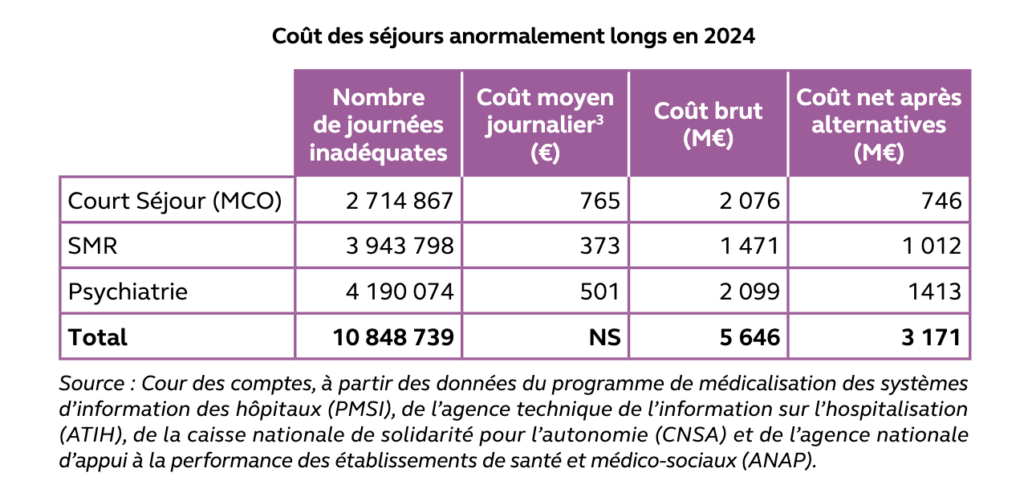
- Inadequate hospitalizations covers hospital admissions that could have been avoided if patients had been treated in town and abnormally long stays. 30,000 beds are occupied every day by patients waiting for more suitable care solutions, for an annual net cost of €4.2 billion. Reducing the number and duration of these hospitalizations is a public health issue. Numerous initiatives are underway but only a territorialized action plan would make it possible to reduce them by 30% in four years, for a net saving of €1.3 billion.
Difficult implementation of the reforms undertaken
The revaluation of small retirement pensions, following the 2023 reform, was presented as a increase of €100 per month for pensions below €1,200. Due to the conditions to be met, only 30% of people receiving a small pension benefited from it, on average of €30 per month for new retirees and €45 for old retirees. For the latter, the implementation resulted in late and sometimes incorrect paymentsdue to difficulties in accessing career data. Information for retirees on their rights remains insufficient.
The professional prevention account (C2P) allows employees in difficult jobs to train for retraining, retire earlier or continue their work part-time. The French system is unstable, complex, poorly controlled and costly in the long term (€1 billion per year in 2060). The Court recommends reform it in depth by simplifying it, reorienting it towards the prevention of professional wear and tear instead of its repair and by entrusting its management to the social partners under the constraint of financial balance.
From 2014 to 2025, the National Family Allowance Fund (CNAF) has carried out 17 reforms of the benefits it manages for social security or on behalf of third parties (State, local authorities, etc.) and the National old age insurance fund (CNAV), 2 pension reforms. These reforms, with high implementation costs, have delayed the essential modernization of their information systems et sometimes have extended processing times for services. The Court recommends improving Parliament’s information, planning more staggered implementations, better training agents and securing part of the resources allocated to information systems for their modernization.
Read the report


