





Adding a healthy option can actually drive people to make even worse choices, thanks to a mind-blowing glitch of human psychology.
In 2017, and to much fanfare, menu labeling for calorie counts began to be mandated in national chain restaurants. Consumers should have the information needed to make healthy food choices outside the home, right? It makes sense that caloric information on menus will help people limit their food intake to stay within their daily energy needs. But it didn’t work. It turns out calorie labels are not effective, shaving off an average of eight insignificant calories per meal.
You could have totally predicted that. Why? Just as one might divine the value of front-of-pack traffic light labeling from the ferocity of the industry response against it, one could probably gauge the futility of calorie labeling by the ease with which some regulations have been passed. McDonald’s voluntarily started publishing calorie information nationally back in 2012 after a labeling mandate in New York City was found to have no overall effect on consumer behavior. Studies suggest such labeling could boost “perceptions of the restaurant’s concern for consumers’ well-being” while carefully not undermining any Big Mac attacks.
At the same time, McDonald’s announced plans to add seasonal produce to its menu. How cynical do you have to be not to at least recognize that as a good thing? Ironically, adding a healthy option can actually drive people to make even worse choices. Ready to have your mind blown?
As I discuss in my video Do Healthy Fast-Food Options Lead to Healthier Choices?if people are offered a choice of side dishes—something unhealthy like French fries or something more neutral like a baked potato—only about 10% of them will splurge for the fries. If an even healthier third option—like a side salad—is added, instead of choosing between an indulgent choice and the more neutral baked potato, people would have their pick of the indulgent choice, the neutral choice, or an even healthier choice. Even if everyone doesn’t choose the salad, more will go for the middle-ground baked potato over the fries, right? So, how much farther does French–fry–fancying fall by adding the salad option to the mix? It shoots uptripling to 33%. Without the salad option, only 1 in 10 chose the fries, but that jumped to a third of people just at the sight of salad.
The same thing happens when you offer people the choice between a bacon cheeseburger, a chicken sandwich, or a veggie burger. In a “No Healthy Option” scenario, where people were offered the cheeseburger, a chicken sandwich, or a fish sandwich, 17% chose the burger. Swap out the fish sandwich for a veggie burger, and the bacon cheeseburger preference doubled to 37%. How can just seeing a healthy option push people to make andhealthier choices?
The paper describing this series of experiments was entitled “Vicarious Goal Fulfillment: When the Mere Presence of a Healthy Option Leads to an Ironically Indulgent Decision.” The thought is that seeing the salad or veggie burger, people make the mental note to choose that at some nebulous next time, thereby giving them the excuse to indulge now.
There is this fascinating glitch of human psychology called self-licensing. This is when we unwittingly justify doing something that draws us away from our goals after we’ve just done something that brings us towards them, like justifying eating a donut because of last week’s weight loss. We reward ourselves with an indulgence that sets us back.
If you give smokers “vitamin C” supplements, they subsequently smoke more cigarettes than if you give smokers what you explain are “placebo” pills (even though both groups were given identical sugar pills). The smokers who thought they were taking supplements smoked nearly twice as much, perhaps subconsciously thinking that since they had just done something good for their health, they could afford to “live a little,” which may have, in effect, caused them to live a little…less.
You can see how this could translate into other lifestyle arenas. Those given placebo pills, which they believed to be dietary supplements, not only expressed less desire to subsequently engage in exercise, but they also followed through by walking about a third less. Compared to those who were told the pills were placebos, the misled participants were also more likely to choose a buffet over what was described as a “healthy, organic meal.” Would they eat more, too? A seminal study entitled “The Liberating Effect of Weight Loss Supplements on Dietary Control” put that to the test.
Participants were randomized to take a known placebo or a purported weight-loss supplement (which was actually just the same placebo) and later covertly observed at a buffet. Not only did the “supplement” subjects eat more food, but they chose less healthy items. They also ate about 30% more candy in a bogus “taste test” and ordered more sugary drinks. “Hence,” the investigators concluded, “people who rely on dietary supplements for health protection may pay a hidden price: the curse of licensed self-indulgence.”
Circling back, what the vicarious goal fulfillment studies discovered is that not only does making progress towards a goal rationalize decision-making that undermines us, but even just considering making progress can have a similar licensing effect. Note that the study participants were not only moved to make the unhealthiis choice, but the unhealthiEast choice. One might assume that even if people didn’t go for the salad or veggie option, the presence of a healthier alternative may have encouraged them to choose something in between—not the healthiest option, but at least not the unhealthiest choice. Instead, it moved people in the opposite direction.
In another “No Healthy Option” scenario of chocolate-covered Oreos, regular Oreos, or golden Oreos, researchers found that adding a “lower-calorie” Oreo option doubled the likelihood that the study participants would go straight for the most indulgent chocolate-covered option. (See below and 6:10 in my video.)
This is attributed to another illogical quirk of human psychology, indelicately named the “what the hell effect.” This is when one forbidden cookie can lead dieters to eat the whole bag. Once you’ve already strayed from your goals, well, why not go all the way? So, once people decide they are going to get that salad next time and spoil themselves just this once, they might as well go for the most indulgent choice.
The halo of healthy foods can even warp our perceptions. Show weight-conscious people a burger and nothing else, then ask them to estimate the calories, and the average answer is 734 calories. Okay, now show folks the exact same burger accompanied by three celery sticks, and they guess the total comes out to 619 calories. Did they think the celery had negative calories? No, most knew the celery had calories, too, but just the juxtaposition of the burger with the celery made the burger seem healthier. The same thing happens when you add an apple to a bacon-and-cheese waffle sandwich, a side salad to beef chili, or some carrots next to a cheesesteak—about a hundred calories appear to disappear, as shown here and at 7:27 in my video.
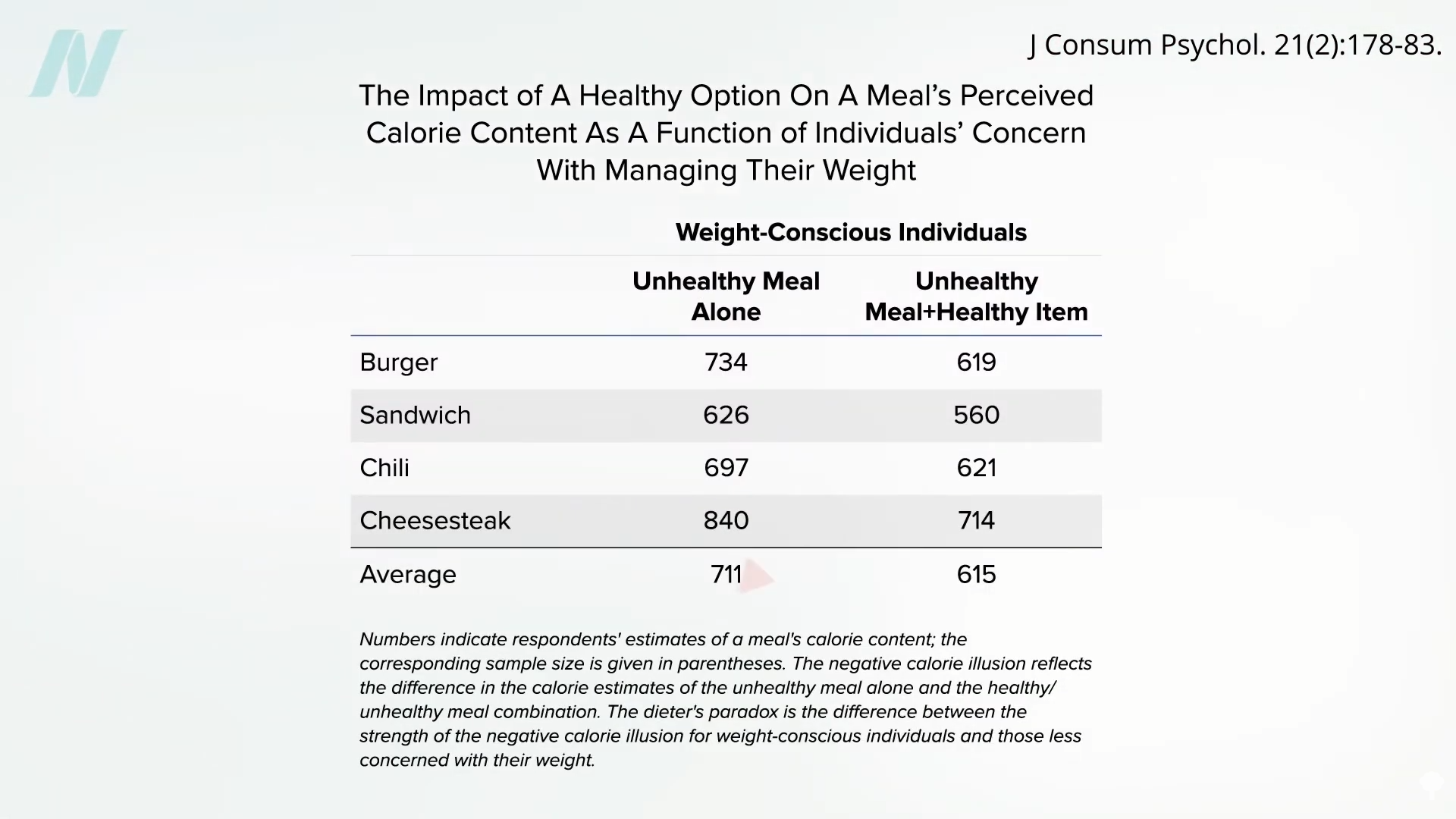
Health halo effects may explain why people are more likely to order a dessert and more sugary drinks with a “healthier” sub at Subway versus a Big Mac at McDonald’s, even though the sub used in the study (filled with ham, salami, and pepperoni) had 50% more calories to begin with.
Even just a reference to healthy foods can do it. Show people a picture of a Big Mac, and people estimate it has 646 calories. Just add the text “For your health, eat at least five fruits and vegetables per day,” and all of a sudden, the same burger in the same ad was thought to only have 503 calories. Merely offering and even promoting salads and fruit can bring McDonald’s accolades and bolster consumer loyalty without, ironically, helping their health.
Doctor’s Note
If you enjoyed this blog, you might also like a video I did on optimism bias: Why Don’t People Eat Healthier?
For more on junk food, see How We Won the Fight to Ban Trans Fat and Ultra-Processed Junk Food Put to the Test.


