





Parkinson’s disease (PD) is one of the fastest-growing neurological conditions in the world. According to the Parkinson’s Foundation, nearly 1 million Americans are living with PD, and more than 90,000 are diagnosed each year.
For ACSM certified professionals, this growth presents both a challenge and an opportunity. As more individuals are diagnosed, exercise professionals will increasingly be called upon after discharge, when structured therapy ends, but the need for movement does not. If exercise is truly medicine, then our role is to facilitate the lifelong prescription.
We are reframing Parkinson’s care. Individuals with PD are not fragile patients; they are athletes in their own right, playing the game of life. Their competitive events may look different than those on the field, but the demands and stakes are even higher and more important than any other competition. They’re competing to live the most fulfilling life possible. We as exercise professionals have the ability to coach them through their sport of life. Our responsibility is to apply evidence-based progression while respecting neurologic considerations.
From Rehabilitation to Long-Term Strategy
Physical therapy is essential throughout the lifespan of someone with Parkinson’s. However, Parkinson’s does not end when therapy does, and too often, individuals complete a short episode of care and are left without a structured, progressive plan.
Over the past decade, research has clarified that exercise is not simply supportive; it is central to long-term disease management. The PARK-in-Shape trial demonstrated that moderate- to high-intensity aerobic exercise improved motor symptoms compared with stretching. The SPARX II trial confirmed that vigorous treadmill training in early PD is safe and feasible, reinforcing that intensity is not only tolerable but potentially protective.
Across research and clinical models, three principles consistently emerge: exercise must be intense, tailored, and consistent. These principles are not theoretical; they are facts that show up every day in the lives of those with PD.
Intensity: Training the Brain by Challenging the Body
Moderate- to high-intensity aerobic exercise appears to stimulate neuroplastic mechanisms that lower-intensity activity may not.
Scott W., diagnosed in 2021, describes intensity as the “anchor” of his weekly routine. Scott participates in twice-weekly training sessions at Movement Revolution, a specialized neuro-based gym in Chicago. He says that his PD-specific program creates accountability and sustained effort for him. “Choosing not to exercise is choosing to give up,” he shares.
His experience aligns with research: Dose matters, effort matters, and structured intensity may help slow motor symptom progression.
For professionals, this reinforces the importance of proper screening, assessment, and adherence to medical precautions and contraindications. When applied safely and progressively, individuals with PD can, and should, train to their highest ability level.
Targeting Symptoms, Not Just Fitness
Hallmark symptoms of Parkinson’s include bradykinesia, rigidity, postural instability, tremor, and dual-task impairments. Proper exercise can be programmed to address these directly.
Dana R., diagnosed in 2024, explains she incorporates targeted strength training for her left side to improve foot drop and balance. Her programming integrates full-body movements and cognitive challenges, improving walking and reducing stiffness. “Exercise has made me feel solid in my body again,” she explains.
That phrase “solid in my body” captures what the literature supports: PD disrupts motor control and body awareness. Task-specific, progressively overloaded training can restore confidence and movement efficiency.
Parkinson’s is heterogeneous and affects every person differently. Exercise programs must evolve with the individual’s symptoms, comorbidities, and life demands. Generic fitness is not enough.
Consistency: The Non-Negotiable Variable
“Use it or lose it” may be common fitness language, but in Parkinson’s, it carries a much more heavily weighted significance.
Julia L., diagnosed in 2019, credits individualized programming and collaborative coaching with helping her maintain function for six years, allowing her to continue playing golf and spending time with her grandchildren. Her story underscores a key truth: Exercise is not an 8- to 12-week intervention. It must be a long-term neurologically stimulating endeavor.
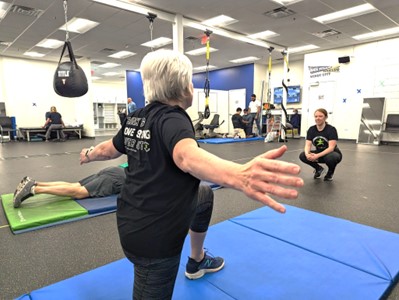
Consistency, however, can be hard to adhere to and requires more than just the data and research; it requires community.
Many individuals with Parkinson’s experience apathy, depression, and progressive isolation. Becoming engaged with group programs, like those at Movement Revolution foster a welcoming, inclusive social environment that fosters belonging and empowerment. These shared experiences reduce isolation. It creates a community of accountability and enjoyment in exercise, which increases retention and overall consistency. Julia notes, “One of the best things about the coaches at Movement is that I’m not treated like I’m sick. When I’m there, I’m just like anyone else working out in the gym.”
Dana also comments on the importance of community and a sense of belonging: “…the friends I have made in the early onset class are Lifesavers– to have a community of people in the same situation is priceless. Movement Revolution feels like such a lifeline. And it gives you something with the exercises, with the classes, with the training to throw yourself into to feel like you’re really helping yourself.”
For ACSM professionals, this reinforces the importance of a behavior change strategy alongside program design.
Closing the Gap: From Therapy to Fitness
One of the most significant vulnerabilities in PD care is the transition after rehabilitation ends. Without a structured bridge to progressive exercise, activity levels often decline.
Post-therapy personalized programming can:
- Reinforce and build off rehabilitation gains
- Safely increase aerobic and strength intensity
- Address evolving balance and dual-task deficits
- Provide measurable progression
- Build accountability and social support
The evolution of exercise as medicine for Parkinson’s care is growing more and more each year. Our role as exercise professionals has never been more important.
National Leadership in Exercise Guidance
This evolution is supported at the national level. The American College of Sports Medicine and the Parkinson’s Foundation collaborated to develop evidence-informed Exercise Recommendations for Parkinson’s disease, outlining guidance for aerobic, strength, balance, and flexibility training across disease stages. These recommendations reinforce what current trials demonstrate: exercise should be frequent, appropriately intense, and a lifelong endeavor.
To further support quality and safety, the Parkinson’s Foundation accredits exercise educational programs that meet established Parkinson’s-specific standards. Accredited programs include Movement Revolution – Neuro Exercise Specialists, Parkinson’s Wellness Recovery (PWR!), Rock Steady Boxing, and Dance for PD. These efforts help clinicians and exercise professionals confidently connect individuals with PD to qualified, evidence-informed programming, strengthening the bridge between medical care and community-based movement.
A Shift in Narrative
For decades, PD has been framed almost exclusively around decline. But research and lived experience challenge that narrative. Exercise is not a cure; it does not 100% eliminate progression, but it is one of the few interventions consistently associated with improved motor performance and meaningful enhancements in quality of life.
As prevalence rises, ACSM professionals are uniquely positioned to extend care beyond rehabilitation and into lifelong movement strategy. When intensity is intentional, exercises are tailored, and consistency is achieved, exercise becomes empowerment.
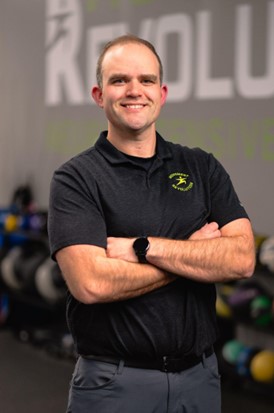
Eric Johnson, CSCS, CIFT, Founder of Movement Revolution, is a Neuro Exercise Specialist specializing in neurologic exercise programming for individuals with Parkinson’s disease and other neurological diagnoses. Movement Revolution’s Neuro Exercise Specialists is a Parkinson’s Foundation-Accredited Exercise Education Provider. Eric and his team focus on bridging the gap between rehabilitation and long-term performance through personalized, evidence-based training.


